 Pastely
 Archly
01
The editor vs the whole day
WakaTime measures time inside editors. Timecard measures every app and website, so coding, review, Slack and YouTube sit on one timeline.
WakaTime tracks coding time through editor plugins, including AI adoption and spend for tools like Claude Code, Cursor, Copilot and Codex, and keeps it on its servers. Timecard reads the history AI tools already keep on your Mac, with no plugins and no account, and puts it next to everything else in your day.
Timecard

WakaTime
01
Best for: coding stats across many editors

Best for: seeing, and limiting, where your Mac day goes
02
Timecard is a single payment. WakaTime is a subscription.
TimecardPay once$5once, for 1 Mac
WakaTimeSubscriptionFrom WakaTime's own pages, October 2026.
Over three years
WakaTime's cheapest paid plan, billed yearly
03
 Timecard | WakaTime | |
|---|---|---|
| Tracking | ||
| Tracks apps automatically | Yes | Coding time inside editors |
| Tracks websites | Yes, in Safari, Chrome, Arc, Dia, Brave, Edge, Vivaldi, Opera and Comet | No |
| History | Forever, plus the weeks Screen Time already kept | One week on the free dashboard |
| Privacy | ||
| Account | Not needed | Required |
| Where your data lives | On your Mac, in one local file | WakaTime's servers |
| Limits | ||
| Limits that block apps and sites | Yes: blocks the tab or covers the app, then asks why | No |
| Beyond tracking | ||
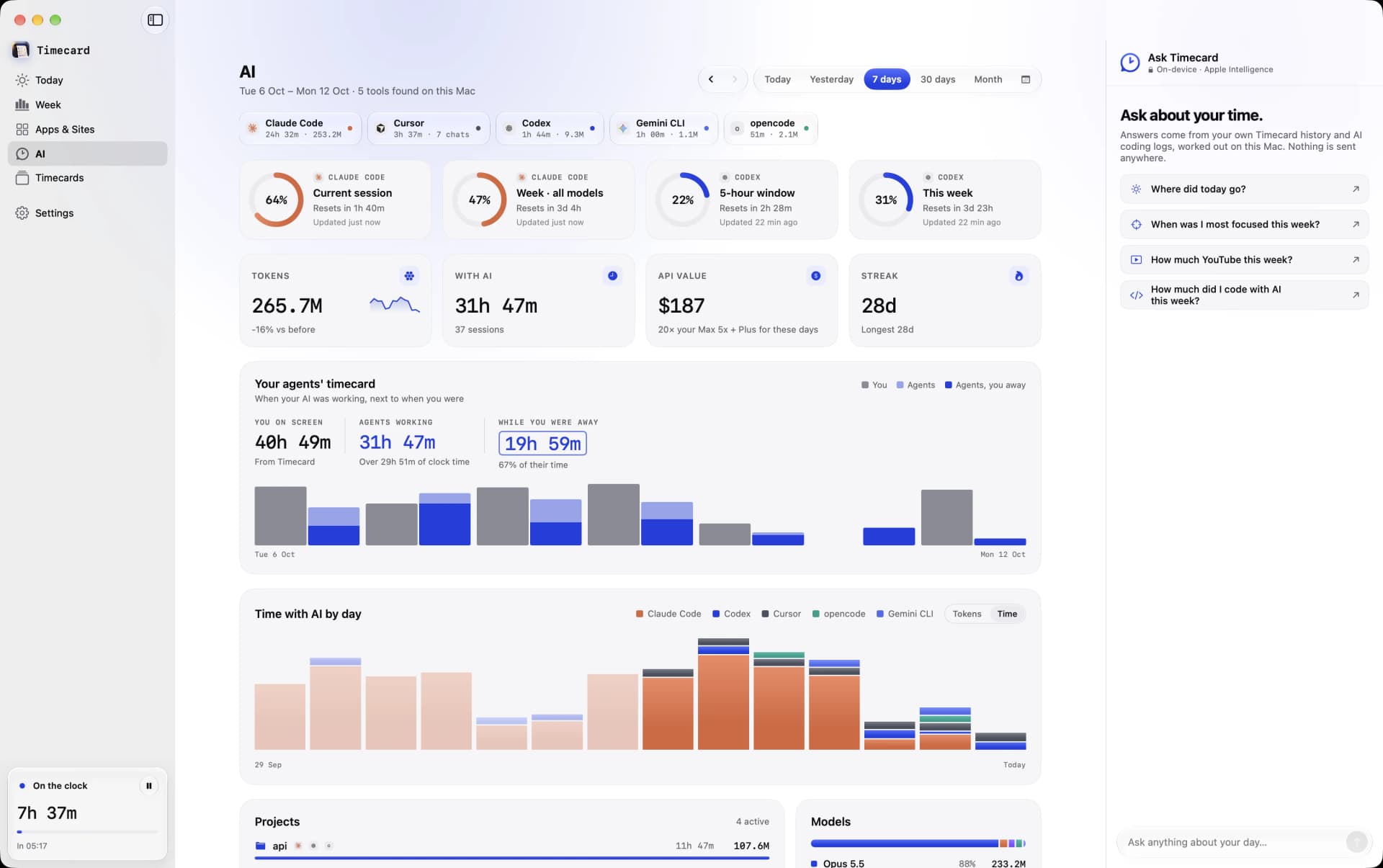
| AI coding usage | Claude Code, Codex, Cursor, opencode, Gemini CLI: time, tokens, API value | Yes: AI adoption, models and spend |
| Daily summary | A timecard printed from the notch every evening | Weekly reports |
| Teams and client billing | No, it's built for one person | Yes, team dashboards |
| Availability | ||
| Platforms | Mac, macOS 14 or later | Plugins for most editors, on any OS |
04
01
WakaTime measures time inside editors. Timecard measures every app and website, so coding, review, Slack and YouTube sit on one timeline.
02
WakaTime needs a plugin in each editor. Timecard reads the history Claude Code, Codex, Cursor, opencode and Gemini CLI already write on your Mac.
03
WakaTime stores stats on its servers. Timecard keeps everything on your Mac, and its MCP server lets your own agents ask about your time locally.
For most people on a Mac, Timecard: it tracks every app and website automatically, keeps the data on your Mac, blocks apps and sites when a daily limit runs out, tracks AI coding usage, and costs one payment with no account. WakaTime is still the better fit if you want per-language and per-project coding stats across many editors.
Yes. It reads their local history and shows time, tokens and API value per session and project, plus how close you are to your plan's limits.
No. It tracks the editor as an app and reads AI tools' local history, so there's nothing to install in each editor.
WakaTime has a free plan with one week of dashboard history. Paid plans start at $8.25 a month billed yearly.
Compare Timecard with
 vs Screen Time
Apple's built-in Screen Time, with four weeks of history.
Open →
 vs RescueTime
A cross-platform tracker with focus sessions, on a subscription.
Open →
Tvs Timing
A Mac time tracker built for projects and client billing.
Open →
Rvs Rize
An AI time tracker with a distraction blocker, on a subscription.
Open →
Tvs Toggl Track
Timers and reports for teams that bill hours.
Open →
Avs ActivityWatch
A free, open-source tracker that keeps data on your device.
Open →
 vs Freedom
A cross-device blocker that doesn't track your time.
Open →
 vs Opal
A phone-first screen time app with Hard Mode, on a subscription.
Open →